
Dialt Preview: Fast and Smart Real-Time Voice Models
Today, we release a preview of Dialt Fast and Dialt Smart to developers, providing low-latency, high-accuracy, real-time voice models.
In our internal benchmark of cross-customer tasks, Dialt models offer an improved combination of speed and accuracy over both Gemini 3.8 Live and GPT Live-1.
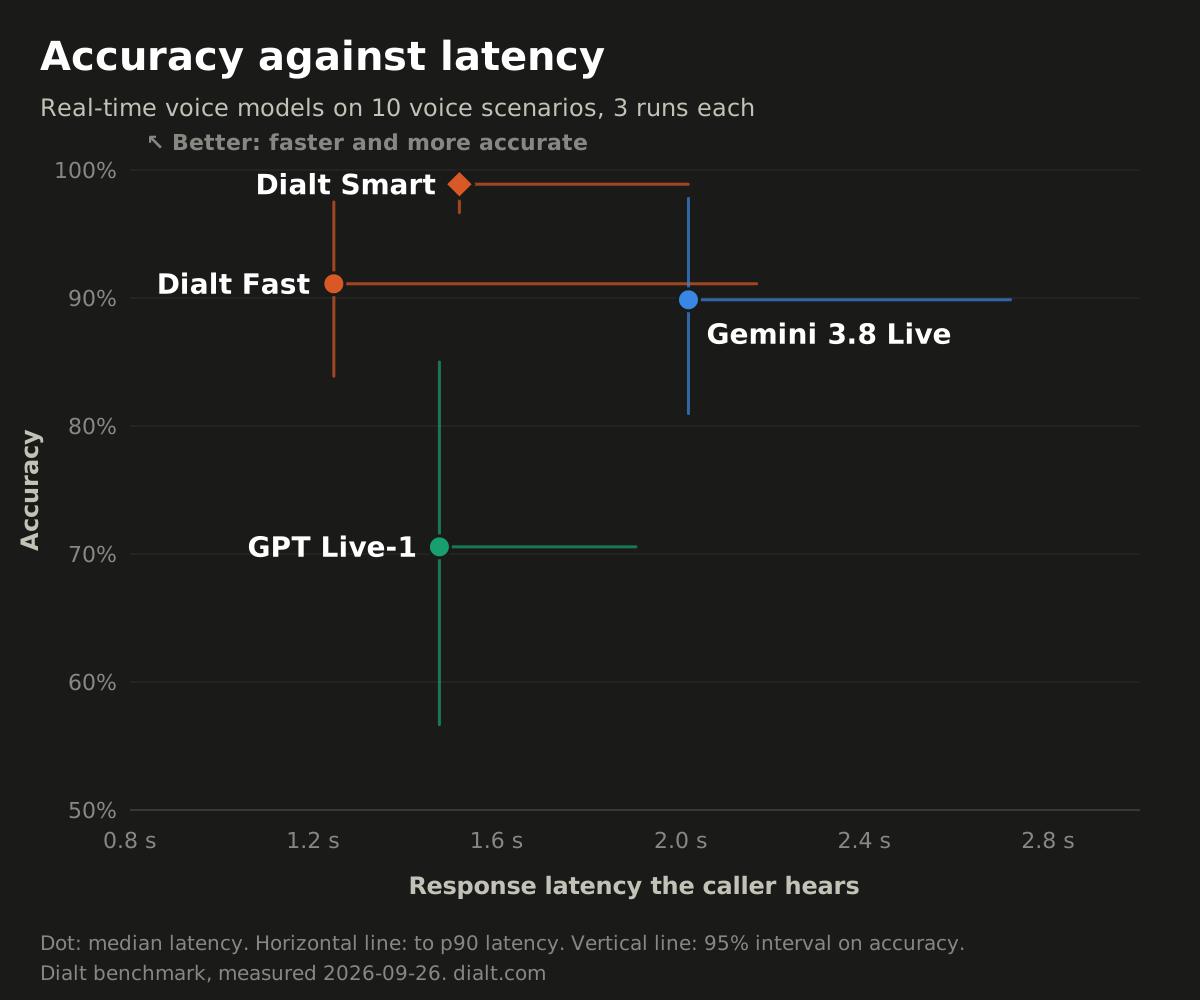
Our internal benchmark
- The benchmark includes ten cross-customer cases, each run three times.
- Voice models are run against a simulated caller, and an LLM judge scores each call on multiple criteria, each with a scoring rubric.
- Latency is measured using post-alignment of audio with text, from the end of the caller's last word to the start of the assistant's first word. The plot shows median (p50) and p90 response durations. Note that p90 measurement error is large at this sample size.
Languages and SDKs
These models support five languages: English, Mexican Spanish, Brazilian Portuguese, Hindi (including Hinglish) and Arabic, and are offered through Dialt's web SDK, Python SDK, Swift SDK, or WebSockets. We also provide experimental support for WebRTC.
Our thesis
Our thesis at Dialt is that one single SDK should allow developers to:
- Create and measure performance on evals that are specific to their application.
- Easily integrate a speech-to-speech model for telephony, web or on-device applications.
- Monitor production performance, with auto-flagging of failures in audio quality, audio understanding, reasoning, tool calling and speech synthesis. Today, sessions are automatically reviewed for outcome, turn-taking, tool-call failures and latency; more categories are coming.
- Operate a self-improving loop based on failures, including the tuning of model weights, to improve performance. This will be coming soon!
We expect to shortly open up Dialt to general release.