
Dialt Cascade: a self-hosted voice engine
Dialt Cascade is the self-hosted version of the voice engine behind Dialt Fast and Smart. You control the realtime endpoint and call recordings and bring your own API keys for transcription, reasoning and speech. You don’t need a GPU.
The commercial license includes private source and two CPU images with the Trelis model weights. See the self-hosted page for license options and pricing.
What runs on your server
Start with Docker Compose on an x86-64 machine with 8 GB of free RAM and 25 GB of disk. Two prebuilt CPU images contain the Dialt services. One runs the call engine and web console; the other aligns the words on the caller and assistant tracks after a call. Compose can also start PostgreSQL and object storage, or you can connect your own.
Point the Dialt SDK at your endpoint, give the assistant your instructions and tools, and make a call in the playground. In Sessions you can listen to either side, see what the assistant heard, and measure the gap between the caller’s last word and the reply’s first word. Use Evals to test the same scenario after a change.
Local interruption detection and hosted speech and language models
While the assistant is speaking, the local Trelis Barge-In Detector listens for a caller trying to interrupt. Its voice isolator helps separate that interruption from background sound. A separate, optional Trelis Voice Isolator can suppress background speakers before transcription. The existing release downloads the weights separately after access is granted.
Three parts of the call use hosted APIs. Meta Muse transcribes the caller. A conversational model chooses a reply or calls one of your tools. Inworld TTS-2 Flash turns the reply into the standard US Female voice. Caller audio goes to the transcription provider, conversation context to the language model, and reply text to the speech provider.
In the Veris run below, Dialt Fast used DeepSeek V4.1 Flash with low reasoning. Dialt Smart used OpenAI GPT-6 Sol with high reasoning for 98.2% of recorded answering rounds; fallback models handled the rest. Both tiers had the same voice, prompt and tools.
Caller interruptions and reply delay on VAmoS Pro
On November 23–24, 2026, Veris tested Dialt on VAmoS Pro. Each of 100 utility billing tasks called for three separate conversations per system. A caller might ask about their payment history, set up a plan and make a payment, all in one call. Veris graded both what the caller heard and what changed on the account. It excluded caller-side failures separately for each system.
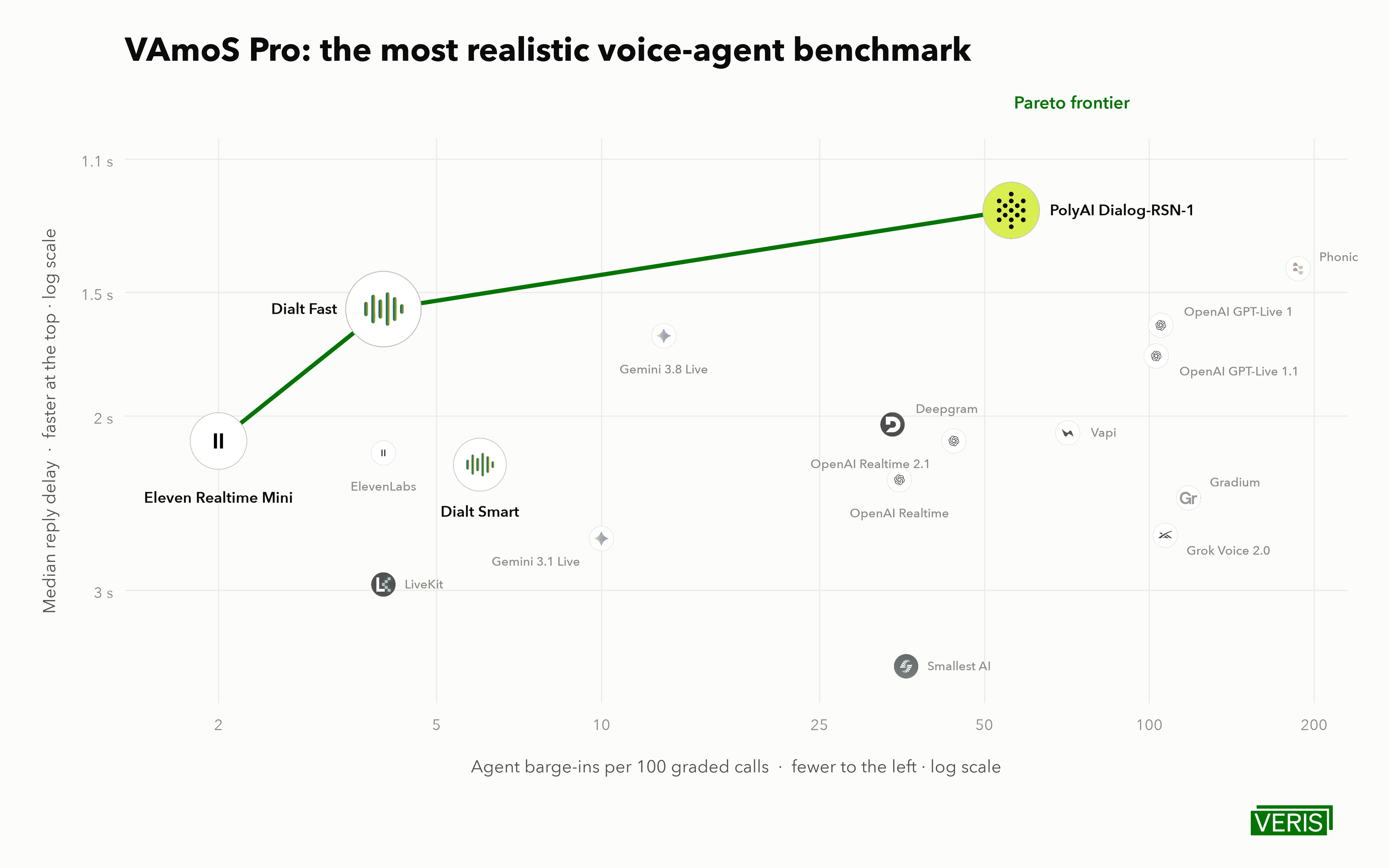
Dialt Fast had about four agent interruptions per 100 graded calls, with a median reply delay of about 1.6 seconds on the Veris chart. Eleven Realtime Mini interrupted less often but replied more slowly. PolyAI Dialog-RSN-1 replied faster but interrupted more often.
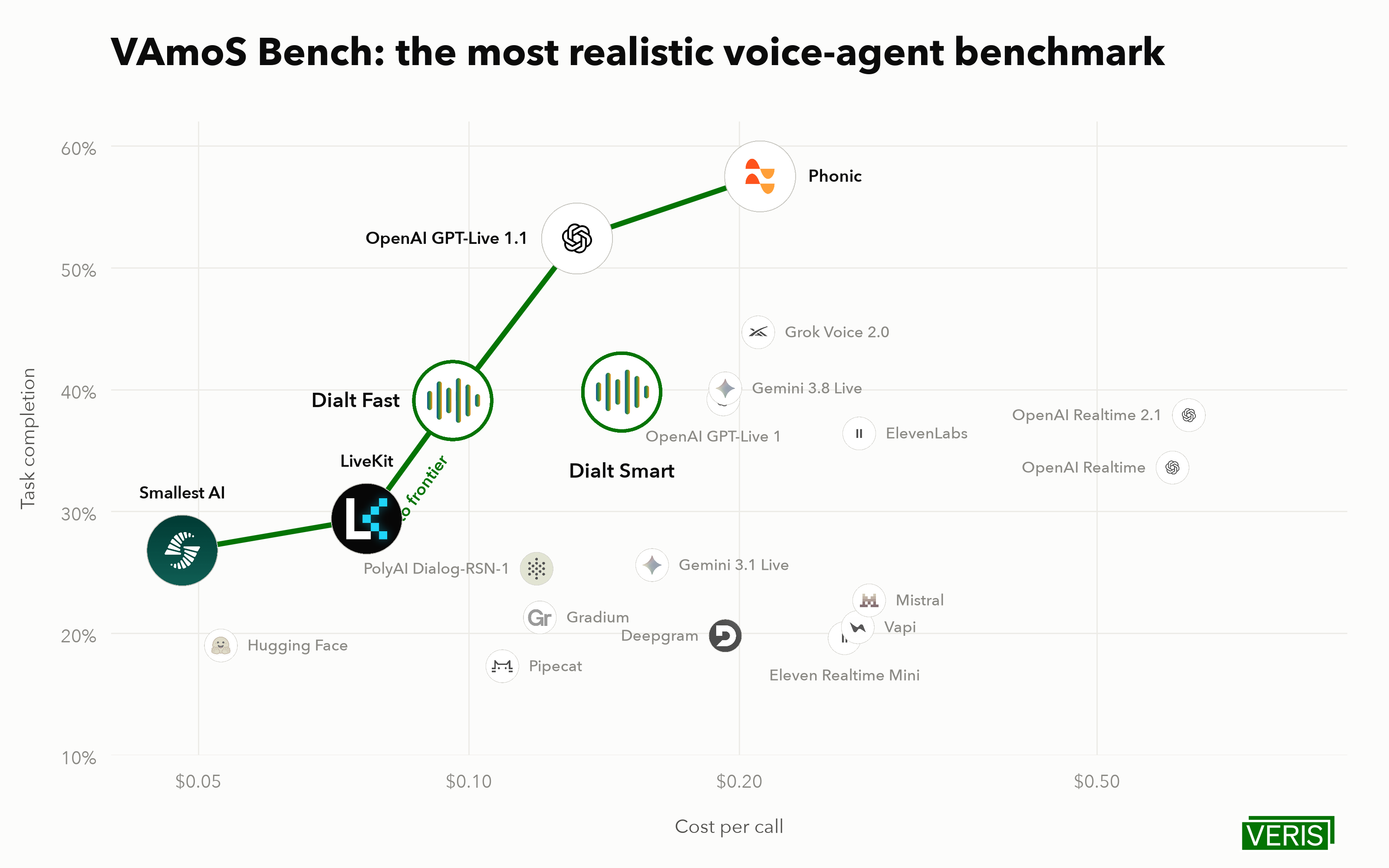
Dialt completed about 39% of graded billing calls and none with background TV
Dialt Fast completed 107 of 274 graded calls (39.1%) at about $0.10 per benchmark call. Smart completed 111 of 279 (39.8%) at about $0.15. Phonic led the chart at 150 of 261 (57.5%). Background TV was a weakness for Dialt: Fast passed 0 of 74 graded TV calls and Smart passed 0 of 72. In some recordings a voice on TV interrupted the greeting before the caller made a request. Both tiers started with pre-transcription speaker suppression off.
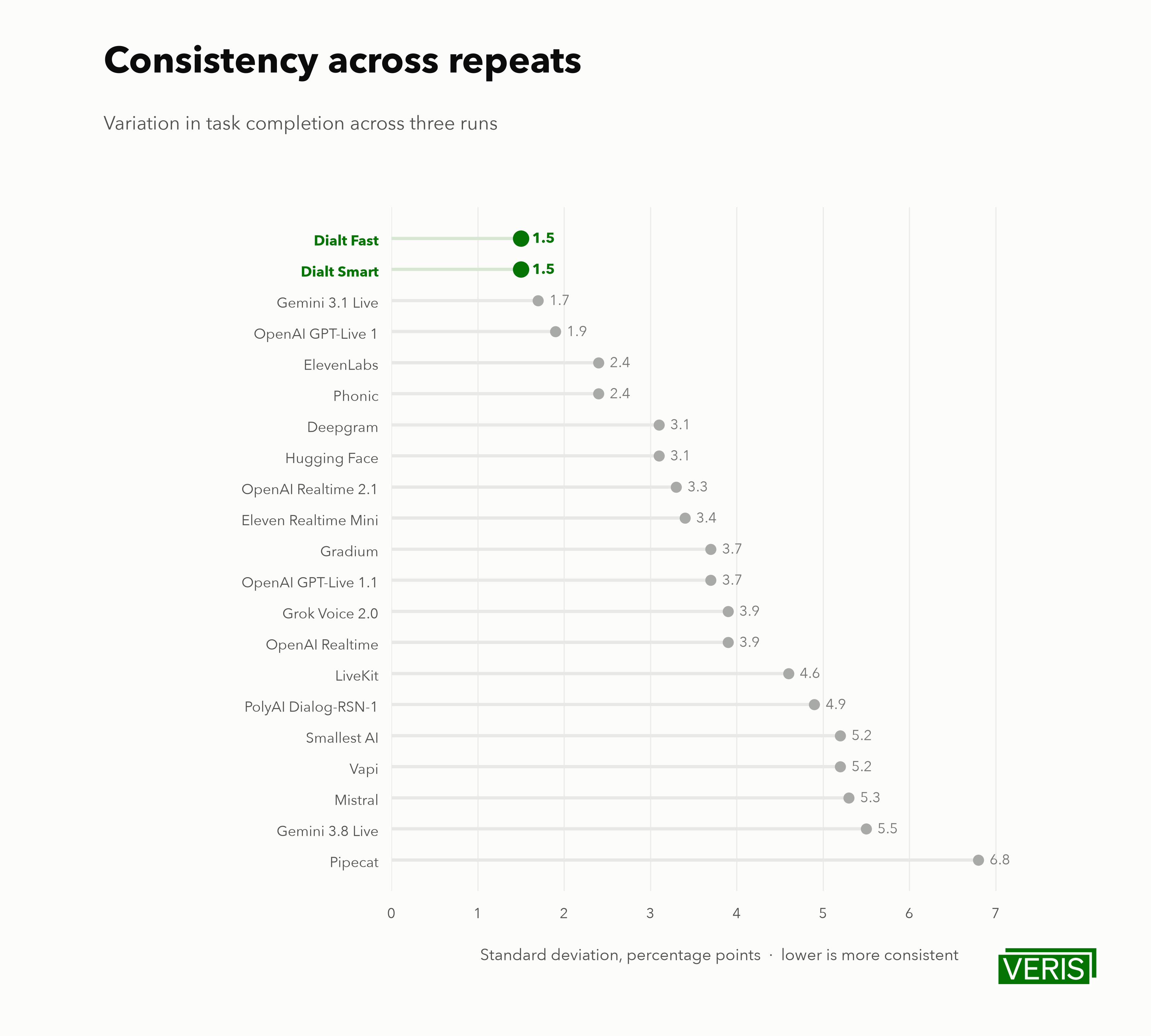
The aggregate completion rates barely moved across the three repeats: both Dialt tiers had a standard deviation of 1.5 percentage points, tied for the lowest shown. Different tasks could pass on each repeat.
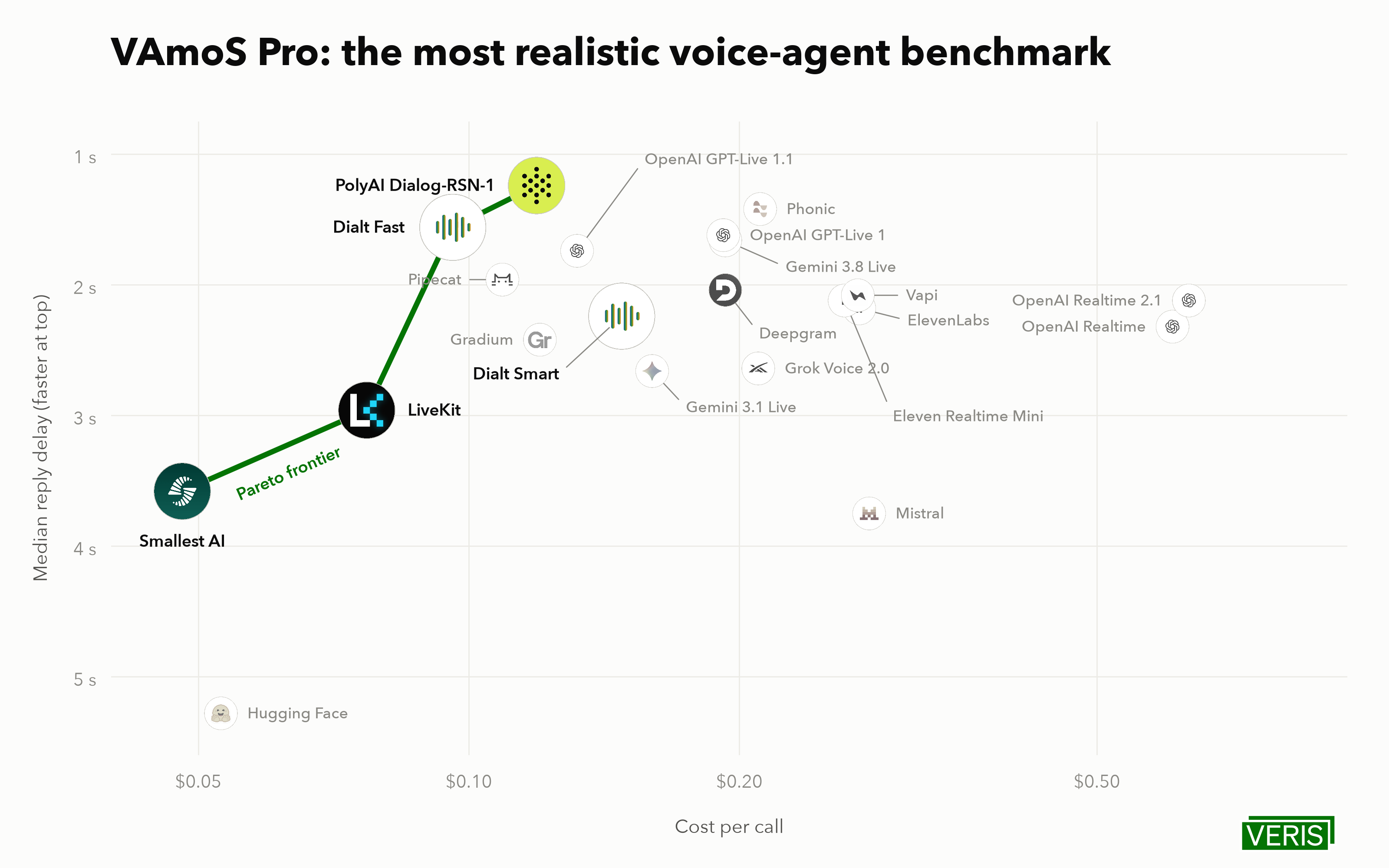
Benchmark cost per call, estimated API cost per minute, and license fees
At about $0.10 per call, Fast had a shorter median reply delay than every cheaper system in this run. The charts use Veris’s cost per whole benchmark call.
For a self-hosted deployment, we estimate 0.92 US cents per connected minute for Fast and 2.41 cents for Smart for the three main provider APIs with the standard US Female voice. This is a budget estimate, separate from the Veris figures. A minute includes pauses; two simultaneous one-minute calls count as two minutes.
Our estimate assumes 30 seconds of assistant speech, 24 seconds of caller speech and six seconds of silence. It allows for generating 50% more speech than gets played and for 3,000 uncached input tokens and 200 billed output tokens per minute. It assumes full use of prepaid speech credits. Budget separately for the software license, hosting, storage, network, telephony, alignment, auxiliary model calls, fees and taxes.
The $500 annual small-business license covers one company’s application plus staging, updates and GitHub issue support. At purchase and renewal, the company group must have fewer than 100 employees and independent contractors combined and less than US$1 million in total revenue from all products and services in the past 12 months.
The $1,000 enterprise evaluation allows production use with live customers for 30 days from working access. It ends automatically. The full evaluation fee counts toward your first separately signed annual production order.